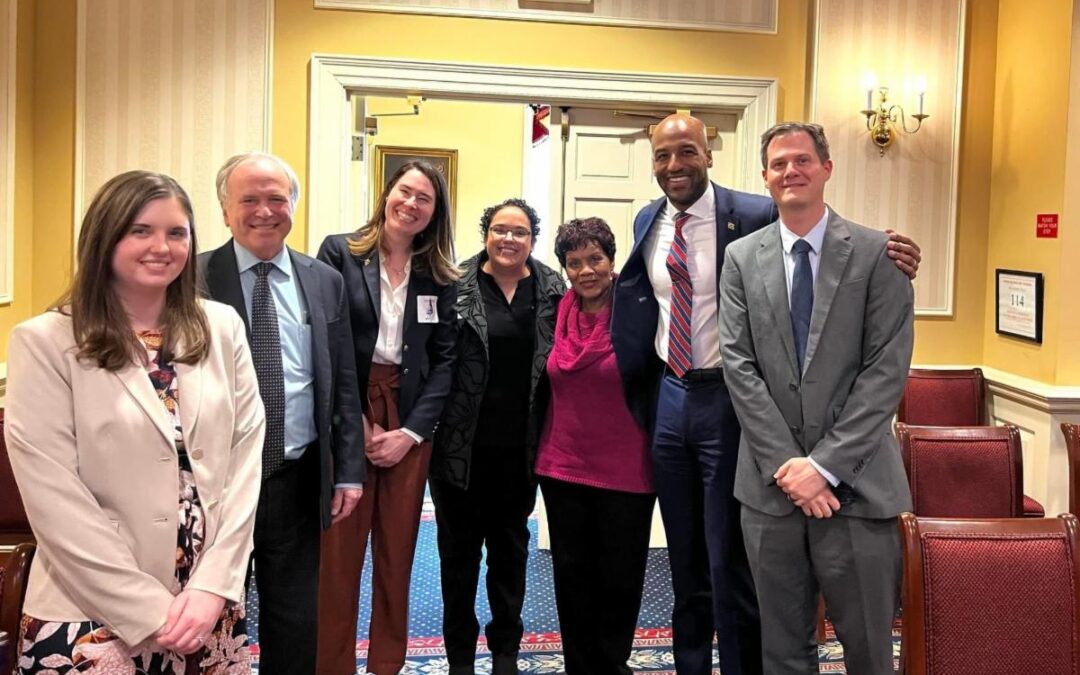
Conservation leaders meet with Del. Dana Stein
Written by Josh Hastings and Andrea Reese, Mark Conway, edited by Ben Alexandro
The 2025 legislative sessions in Maryland and Virginia unfolded under extraordinary pressure, from historic budget deficits and political gridlock to a record volume of energy and land use legislation. In Maryland, an early-session $3.2 billion budget gap drove deep cuts to conservation and environmental programs, even as conservation partners rallied to prevent far worse outcomes. Meanwhile, Virginia’s compressed session offered fewer direct threats, allowing advocates to focus on proactive goals, though major initiatives like the Virginia’s Great Outdoors Act and Oak Hill State Park fell short. Taken together, the sessions reflected both the volatility and the opportunity that define the current landscape for conservation policy across the Chesapeake Bay watershed.
Maryland
The Maryland General Assembly’s 447th Legislative Session concluded on April 7th and was widely regarded as one of the most difficult in the past 25 years. Facing a $2.9 billion structural deficit before session began—and a projected $3.2 billion gap by session’s end—lawmakers and the Governor’s office were forced to scale back, delay, or roll back key initiatives, including investments in electric public transit, energy programs, and the “Blueprint for Education.”
Despite economic pressures, Maryland passed a balanced budget as required by law, though at the cost of reduced conservation and energy-related investments. Over the 90-day session, more than 2,600 bills were introduced, with roughly 15% addressing environmental, conservation, or land use issues.
CONSERVATION BUDGET OUTCOMES
Conservation funding faced steep proposed cuts, with the Department of Legislative Services recommending the elimination of funds for three consecutive years. Thanks to coordinated efforts by partners within the Partners for Open Space coalition and the Citizens Campaign for the Environment, the most severe reductions were avoided. The final agreement redirects $25 million annually from Program Open Space (stateside) over four years—a $100 million total reduction—but avoids a full elimination of funds.
Noting that the funding is based upon the real estate market and projected “over and under attainment” of those funds, see the chart below for a comparison of what the final FY26 budget numbers were and how different it was from FY24:
- Maryland Agricultural Land Preservation Foundation (MALPF):– $94M in FY24, to $6.7M in FY26;
- Rural Legacy: — $33M in FY24, to $4.4M in FY26;
- Program Open Space – Local: — $89M in FY24, to $25M in FY26; and
- Program Open Space – Stateside: — $76M in FY24, to NOTHING in FY26.
Maryland’s Heritage Areas will receive $6M in FY26, and this year’s budget, for the first time, includes a specified $5.6M for public access. Of particular concern was the treatment of the Greenspace Equity Program, which experienced its funding being removed and targeted to parks that may not qualify and that did not go through the program application process.
ENERGY & LAND USE: SOLAR SITING, NEXT GENERATION ENERGY ACT, WILDLANDS, ETC.
This session saw a record number of bills—67 in total—focused on energy infrastructure, renewable energy siting, data centers, and related land use issues. Several notable bills passed:
| HB0270 (SB0116) | Data Center Impact Analysis and Report | Delegate Crosby |
| HB0717 | Natural Resources – Public Lands – Acquisition, Staffing, Operations, and Funding | Chair, Environment and Transportation Committee |
| HB1036 (SB0931) | Public Utilities – Generating Stations – Generation and Siting (Renewable Energy Certainty Act) | Delegate Wilson |
| SB0399 | Natural Resources – Wildland Areas – Overhead Transmission Lines | Senator McKay |
| SB0937 (HB1035) | Public Utilities – Electricity Generation Planning – Procurement, Permitting, and Co-Location (Next Generation Energy Act) | President |
HB0270 (SB0116) – Data Center Impact Analysis and Report will create an official study by the State of Maryland on the impacts of data centers. The study will look at data centers with regards to energy consumption and the impact on the state Renewable Portfolio Standard (RPS) and the 14.5% carve-out for solar – much of which is ground mounted and can come in conflict with lands for Best Management Practices (BMPs) or prime agricultural lands and high-class soils.
HB717 – Natural Resources – Public Lands – Acquisition, Staffing, Operations, and Funding was strongly amended but the positive and noteworthy component is that it allows the Maryland DNR to utilize a foundation, to work with the Maryland Park Service, the Maryland Forest Service, the Wildlife and Heritage Service, and others to solicit and accept funds for improvements to expand and enhance the equitable use of and access to lands managed by the Department. This may include activities to support innovative projects that enhance visitors’ experiences at lands managed by DNR, including educating visitors, increasing inclusivity, supporting sustainability, and promoting health and wellness.
SB0399 – Natural Resources – Wildland Areas – Overhead Transmission Lines was a bill that sought to allow one individual company to place overhead transmission lines through Maryland’s most vital protected areas – the Wildlands. Several partners worked to get this bill heavily amended. The bill passed, but under the rules that transmission had to follow current energy transmission corridors, with no more than 200 feet of disturbance on either side of where the energy lines are located.
The Renewable Energy Certainty Act (HB1036/SB931) was the General Assembly’s long-awaited bill to comprehensively address solar siting and solar energy development in a more equitable way. The highly amended bill was made better with a limit of 5% of Priority Preservation Area (PPA) lands, before local governments could be more restrictive with placement. That being said, it opens the door to more intense development until a county reaches the 5% threshold. This may have the unintended consequence of leading countries to want to shrink their PPAs.
SB937 – Electricity and Gas – Emissions Reductions, Rate Regulation, Cost Recovery, Infrastructure, Planning, Renewable Energy Portfolio Standard, and Energy Assistance Programs (Next Generation Energy Act) was amended beyond recognition and became a 75-page bill that sought to get rid of the Renewable Portfolio Standard, in favor of a “Clean Energy Portfolio Standard” that would include nuclear energy. This is the state’s response to addressing climate change emissions in a more timely manner.
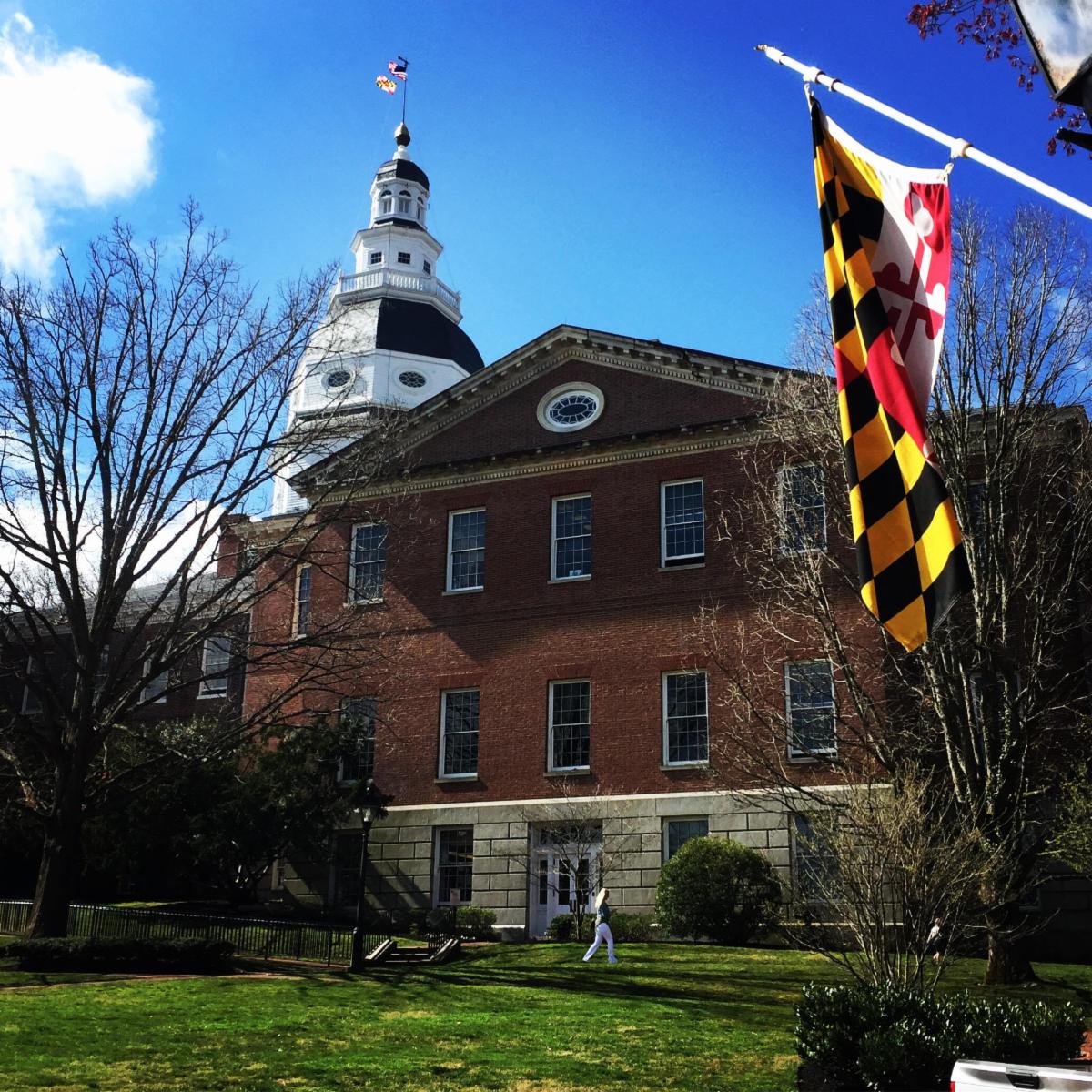
Maryland State House in Annapolis
Looking Ahead in Maryland
While the outcome could have been much worse for conservation funding, it was not a strong session for land conservation funding or for the funding of other established environmental programs. To get back to the levels before this session, a lot of work will need to be done next year and in future years to pay back the dedicated funding. It is widely expected that there will be a special session in the fall of 2025. This special session might be an opportunity to address serious oversights from this past session, most notably, reinstating the lost funds intended for the Greenspace Equity program.
The record number of energy and land use bills was primarily a result of the proposed Maryland Piedmont Reliability Project (MPRP), which is proposed to bring new energy transmission lines across Baltimore, Carroll and Frederick Counties. Maryland’s continued energy and land use conflicts can be met with sound planning. This is an opportunity for partners to work together to help local governments plan to meet large, region-wide challenges. With regard to planning for energy transmission, data center siting, renewable energy deployment – let alone the need for Bay restoration- this past legislative session was just the beginning.
The Department of Legislative Services’ “90 Day Report” is a great resource to show a broad summary of all legislative actions, including the state budget.
Virginia
Virginia’s 2025 session started with unexpected challenges—a major storm took out Richmond’s water service, leaving the General Assembly to gavel in and get back out of town until the Capitol Building’s water, the fire control system, and the plumbing could be restored. What was already a 45-day short session became even more compressed. Two weeks into the session, the new administration in Washington began rapidly changing the federal landscape, turning an anticipated state budget surplus into a potential mirage. Political division in an election year added further complications between the Republican Governor and the Democratic-majority House and Senate.
Against this challenging backdrop, multiple organizations joined forces to amplify the call to conserve more Virginia lands and waters. Coalitions such as the Virginia Conservation Network, Our Virginia Outdoors, and Virginia’s United Land Trusts showed up at committee hearings and legislators’ offices, wrote to lawmakers in support of bills and budget items, and publicized calls to action.
Virginia conservationists had some luck this year in that there were no bills that were critical to oppose, unlike many past years of playing defense. Instead, this year permitted a focus on proposals to support.
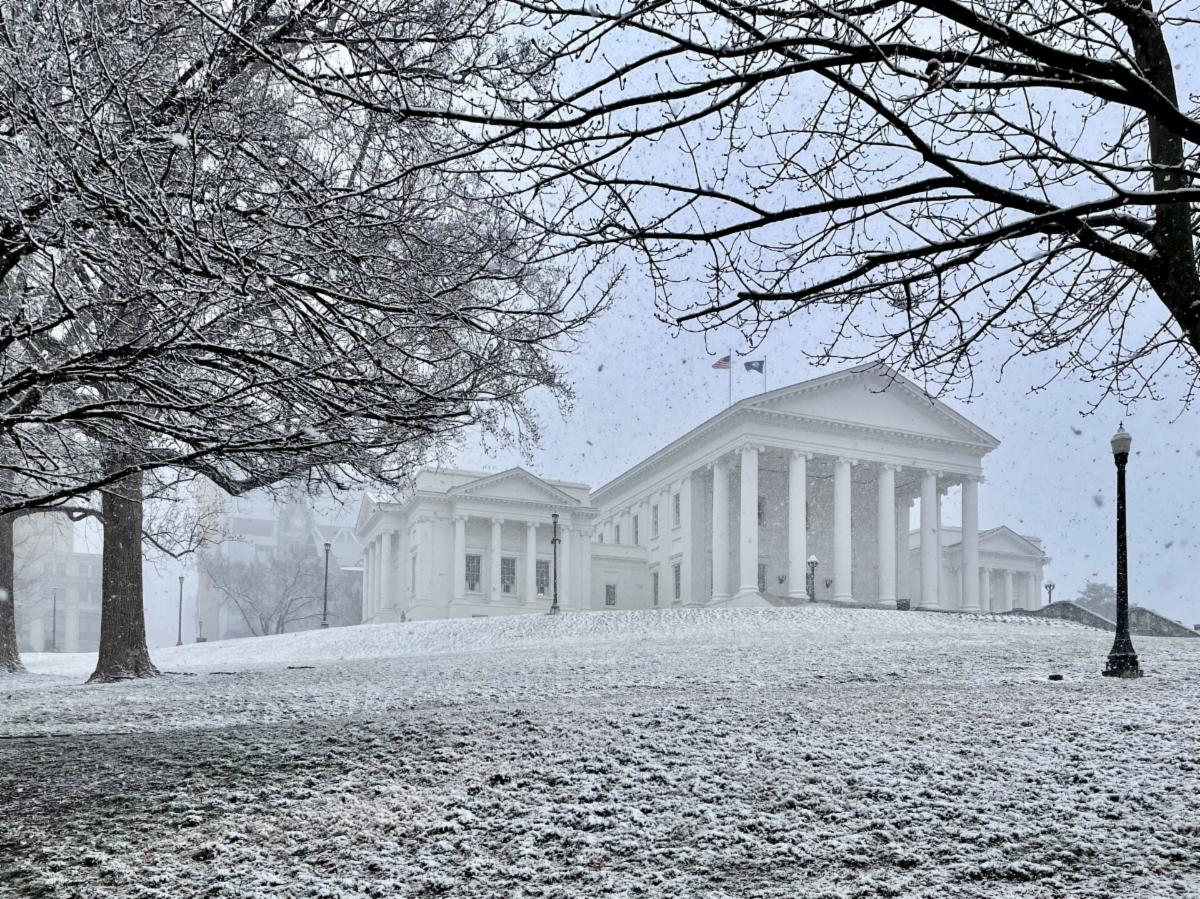
Virginia Capitol Building
Land conservation priorities for the 2025 session included:
- Advancing the Virginia’s Great Outdoors Act (HB2059). This bill, introduced for the second year, would have created a dedicated funding stream of $230 million annually for conservation grants, public-access lands, and outdoor recreation. The House Appropriations Committee heard the bill, but it did not move further. No legislator has yet been willing to vote against the bill, so advocates will keep building support, examine multiple revenue sources, and introduce the bill again next session.
- Supporting legislature-defined conservation goals (SB1198). Proposed setting long-term, legislatively defined conservation goals to provide continuity beyond gubernatorial administrations. Legislators are interested in continuing to develop this bill and trying again next year.
- Supporting tree preservation during development. While proposals to give localities more control over preservation goals (HB2638, HB2238) did not pass, a bill authorizing localities to create tree canopy funds (HB2630) successfully became law.
- Enabling Oak Hill to become a state park (HB2306). This offer would have brought President James Monroe’s 1,200-acre estate and $46 million in funding to the state park system. However, it could not overcome the financial staff’s objections, despite last-minute support from the Governor. Articles in the Washington Post and CBS News tell the full story. Led by The Conservation Fund, project advocates hope to find another path.
Virginia’s land conservation community continues the work now that the legislative session is over. The time between sessions gives the most chances to develop relationships with lawmakers and their staff members. A key priority is to help Virginia lawmakers – and candidates for November’s elections – better understand the ways that conservation lands are funded now, the needs for improvement, and the many ways communities would benefit. Partners are advocating at the federal level, too, for funds and staffing that impact conservation work at the state level. In this fast-moving landscape, collaboration with partners remains the key to advancing conservation.
Implications and Staying Connected:
As the dust settles on 2025 legislative sessions, Maryland and Virginia are navigating the challenges of these unprecedented times to find new inroads to support conservation and environmental stewardship. By addressing emerging issues including growing energy infrastructure, renewable energy siting and the impacts of data centers, these legislative measures are laying the groundwork for future efforts around these issues that are of great interest to partners across the watershed. Despite uncertainties around available conservation funding, CCP continues to monitor available funding opportunities (federal, state, ect.) and educate on the importance for funding this incredible work across the Chesapeake Bay Watershed.
As we look ahead, it is vital to stay informed on what is happening at the legislative level so we can stay on top of the pressing issues and opportunities concerning land conservation. There are a number of statewide partnerships that follow conservation issues closely and have a wealth of of knowledge and expertise on the legislative measures in each state such as Virginia’s United Land Trusts and Virginia Conservation Network, in Virginia and Partners for Open Space and Forever Maryland, in Maryland. For more information, a number of organizations developed session recap presentations including the Virginia Conservation Network’s recap of the 2025 VA general assembly and the Chesapeake Conservancy‘s, in partnership with the Chesapeake Bay Foundation, recap of the 2025 MD and VA general assembly.
Photo credits:
- Josh Hastings, Chesapeake Conservancy
- Josh Hastings, Chesapeake Conservancy
- Andrea Reese, Reese Conservation Consulting LLC
Lightning Update is a regular communication of the Chesapeake Conservation Partnership. Any opinions expressed are those of the authors and do not necessarily reflect positions of the Partnership or member organizations.
To share a success story, news, or important event, send your information to:
Support for the Chesapeake Conservation Partnership is provided by:
National Park Service Chesapeake
EPA Chesapeake Bay Program
USDA Forest Service
Pennsylvania Department of Conservation & Natural Resources
Maryland Department of Natural Resources
Virginia Outdoors Foundation
US Fish & Wildlife Service
Chesapeake Conservancy
The Chesapeake Conservation Partnership is co-convened by: